
Understanding the history of solid surface first requires a look back at its forerunner. The first industrial laminates were developed as early as 1907 at Westinghouse in Pittsburgh, Pennsylvania, where they served a purely functional purpose as electrical insulation casing, manufactured in a simple caramel brown color derived from phenolic resin. In 1913, two Westinghouse employees who saw greater potential in the material left to form a new company, a name derived from their product’s purpose as a substitute “for mica”: Formica.
For decades, laminate remained an industrial product. The catalyst for its domestic transformation was a chemical innovation: the invention of melamine resin in 1938. Melamine could be baked to form a hard, clear topcoat, protecting a decorative paper layer beneath. This breakthrough unlocked a world of color and pattern, but its widespread adoption was delayed by the Great Depression and World War II. It was in the unprecedented post-war housing boom of the late 1940s and 1950s that laminate truly exploded into the public consciousness. Brands like Formica and Wilsonart became household names, and by 1979, plastic laminate commanded an astonishing 90% of the countertop market.
The Cracks in the Veneer: The Inherent Limitations of a Layered Product
Perhaps the most persistent issue was the seams. Joining two pieces of laminate created a visible dark line where the substrate was exposed, an aesthetic compromise that was a constant reminder of the material’s artificiality. Despite its popularity, laminate was built on a fundamental design flaw: it was not a solid, homogeneous material. Its structure consisted of layers of kraft paper or particleboard fused together and topped with a thin decorative sheet and a clear melamine resin coating. This layered composition was the source of all its weaknesses, creating a shared set of frustrations for millions of homeowners.
The thin top layer, while easy to clean, was highly susceptible to damage. Knives could easily scratch the surface, hot pots and pans could leave permanent burn marks, and acidic liquids could cause stains. More significantly, because the design was only on the top layer, this damage was irreparable. A deep scratch, chip, or burn could not be sanded or buffed out; it was a permanent flaw that often necessitated the replacement of the entire countertop. This reality positioned laminate as a product with a relatively short lifespan, typically estimated at 10 to 20 years.
These delaminations and damage to the surface layer provided a place for dirt, crumbs, and bacteria to accumulate and, more damagingly, were an entry point for moisture. Water seeping into the seams could cause the underlying particleboard to swell, bubble, and delaminate, leading to catastrophic failure of the countertop. The market was saturated with a product that, while loved for its look and price, was destined to fail in predictable ways. This widespread, firsthand experience with laminate’s shortcomings created a powerful, latent market demand for a surface that could deliver both beauty and true, lasting performance.
The DuPont Innovation: The 1967 Birth of Corian® and a Material Revolution
In the early 1960s, the leadership at E. I. du Pont de Nemours and Company recognized the strategic opportunity created by the limitations of existing countertop materials. The company, with a long history of pioneering new materials, saw a clear market need for a surface that combined the aesthetic elegance of natural stone with superior practicality for everyday use. This vision set in motion a research and development effort that would fundamentally reshape the surfacing industry.
A Mandate for a Marble Alternative
The project began in earnest in 1963 when DuPont assembled a diverse team of scientists. Their mandate was explicit: to invent a new material that could rival traditional high-end surfaces like marble, granite, and stone, but without their inherent drawbacks. Marble, while beautiful, was porous and stained easily; granite, while durable, required sealing and could be difficult to fabricate. DuPont sought to engineer a material that was non-porous, durable, easy to maintain, and aesthetically versatile; a perfect synthesis of beauty and performance.
The Inventor and the Invention
At the heart of this scientific endeavor was Dr. Donald Slocum, a DuPont biochemist. After several years of research, Slocum and his team achieved a breakthrough. In 1967, they perfected a new composite material that met all of the project’s ambitious goals. DuPont moved quickly to protect its invention, filing for a patent that same year, which was officially granted in 1968 with Dr. Slocum listed as the inventor. The new material was given the trademarked name Corian®.
The “Magic” Formula: A Homogeneous Composition
The genius of Corian® lay in its revolutionary composition. Unlike the layered structure of laminate, it was a solid, homogeneous material, meaning it was the same all the way through its thickness. This structural integrity was the key to its superior performance. The formula was a precise blend of two primary components: approximately one-third acrylic resin (specifically, Polymethyl Methacrylate, or PMMA) and two-thirds natural minerals. The primary mineral filler was Alumina Trihydrate (ATH), a fine, pure white powder derived from bauxite ore, the same raw material used to produce aluminum.
This combination of a flexible, durable acrylic binder with a hard mineral filler, along with various pigments for color, resulted in a material that was completely non-porous. This single characteristic gave it an immediate and profound advantage over both laminate and natural stone. Its non-porous nature made it inherently hygienic, as it would not support the growth of bacteria, mold, or mildew, and it was highly resistant to staining.
The Houston Debut: A “Space Age Material” is Unveiled
With the product perfected and patented, DuPont prepared for its commercial launch. The choice of venue for this debut was a masterful stroke of marketing. In 1971, Corian® was formally introduced to the world at the National Association of Home Builders meeting in Houston, Texas. This location was not arbitrary. In the early 1970s, at the zenith of the Apollo program, Houston was the global epicenter of technology, progress, and American ingenuity. By launching there, DuPont deliberately tied its new product to the cultural zeitgeist of the Space Race.
Marketed as a “space age material,” Corian® was presented as a piece of the future, an innovative leap forward in home design. Initially available only in a clean, modern white, it was demonstrated as a revolutionary alternative to traditional worktops. The launch was a success, spawning a new industry and leading to the establishment of the first Corian® manufacturing plant in Buffalo, New York.(DuPont’s Yerkes site in Tonawanda (Buffalo), originally built for rayon/cellophane in the 1920s, later became the company’s primary Corian® Solid Surface manufacturing location; most Corian is produced there today.) The strategic decision to debut in Houston immediately framed Corian® not merely as a countertop, but as a symbol of technological optimism and advanced engineering, an identity that would propel its growth for decades to come.
The Disappearing Act: The Power of Inconspicuous Seams
One of the most immediate and visible advantages of solid surface was its ability to create seamless installations. Where laminate joints were obvious, often showing a dark line and creating a trap for dirt and moisture, solid surface could be joined with a chemically bonding, color-matched adhesive. A skilled fabricator could apply the adhesive, clamp the pieces together, and then sand the cured seam until it became virtually invisible to the eye and touch. This created the illusion of a single, monolithic piece of material, a clean and high-end aesthetic that laminate could never achieve. This feature was not just cosmetic; it also eliminated the hygienic weak point that plagued laminate seams.
A Renewable Surface: The Revolution of Repairability
Perhaps the most profound functional leap offered by solid surface was its repairability. Because it is a solid, homogeneous material, minor damage is not a permanent catastrophe. Scratches, nicks, small chips, and even minor scorch marks from hot pans could be sanded out by a professional, restoring the surface to its original, like-new condition. This concept of a renewable surface was revolutionary. It transformed the countertop from a disposable item with a 10-20 year lifespan into a long-term, maintainable asset designed to last for 25 or more. This durability and longevity offered a completely different value proposition to homeowners.
Design Freedom: Thermoforming and Integrated Sinks
Solid surface also unlocked a new dimension of design flexibility. The acrylic resins in its composition allow the material to be thermoformed. When heated in a specialized oven to a temperature of around 230-330°F (approximately 110-165°C), the solid sheet becomes pliable, like a “thick wet lasagna noodle”. It can then be draped over molds and formed into smooth, elegant curves, three-dimensional shapes, and custom designs that would be impossible with rigid laminate or even natural stone. Furthermore, this workability allowed for the creation of seamless, integrated sinks made from the same solid surface material as the countertop, creating a fluid, easy-to-clean, and highly modern look.
From Monopoly to Mainstream: The Maturation of the Solid Surface Industry
The initial launch of Corian® in 1971 marked the birth of a new product category, but for two decades, it was a category with only one member. DuPont’s patent protection created a unique market dynamic, allowing the company to carefully cultivate the brand and establish solid surface as a premium material before the inevitable onset of competition. The expiration of that patent in the late 1980s was a watershed moment, transforming solid surface from a single product into a dynamic, diverse, and competitive global industry.
The sudden shift from a monopoly to a competitive landscape had a profound and positive impact on the industry. The fierce competition for market share fueled rapid innovation. The range of available colors, patterns, and textures expanded dramatically, from simple solids to complex designs that mimicked natural stone, concrete, and other materials. This explosion of choice gave architects and designers a much richer palette to work with.
A craftsman could no longer simply master the nuances of Corian®. They now had to become an expert in a diverse category of materials with different acrylic and polyester blends, varied fabrication requirements, and a wide array of specialized adhesives. The era of the versatile, multi-material solid surface artisan had begun.
Steve Cloutier and the Rise of Onmark LLC
History is often told through grand narratives of invention and market shifts, but it is lived and shaped by the individuals on the ground. The story of solid surface’s maturation from a novel invention to a mainstream staple is mirrored in the professional journey of craftsmen who dedicated their careers to mastering the material. Steve Cloutier, the founder of Onmark LLC, is one such craftsman, whose 35-year career began at the very moment the industry was transforming, positioning him to become a master of his trade as the trade itself was being defined. He gained hands-on experience with the old standard laminate, while simultaneously witnessing and working with the burgeoning new category of solid surfaces from a variety of manufacturers. This unique vantage point provided a direct, real-world education in the comparative strengths and weaknesses of both material classes.
The Craftsman’s Mastery: Tools, Techniques, and Expertise
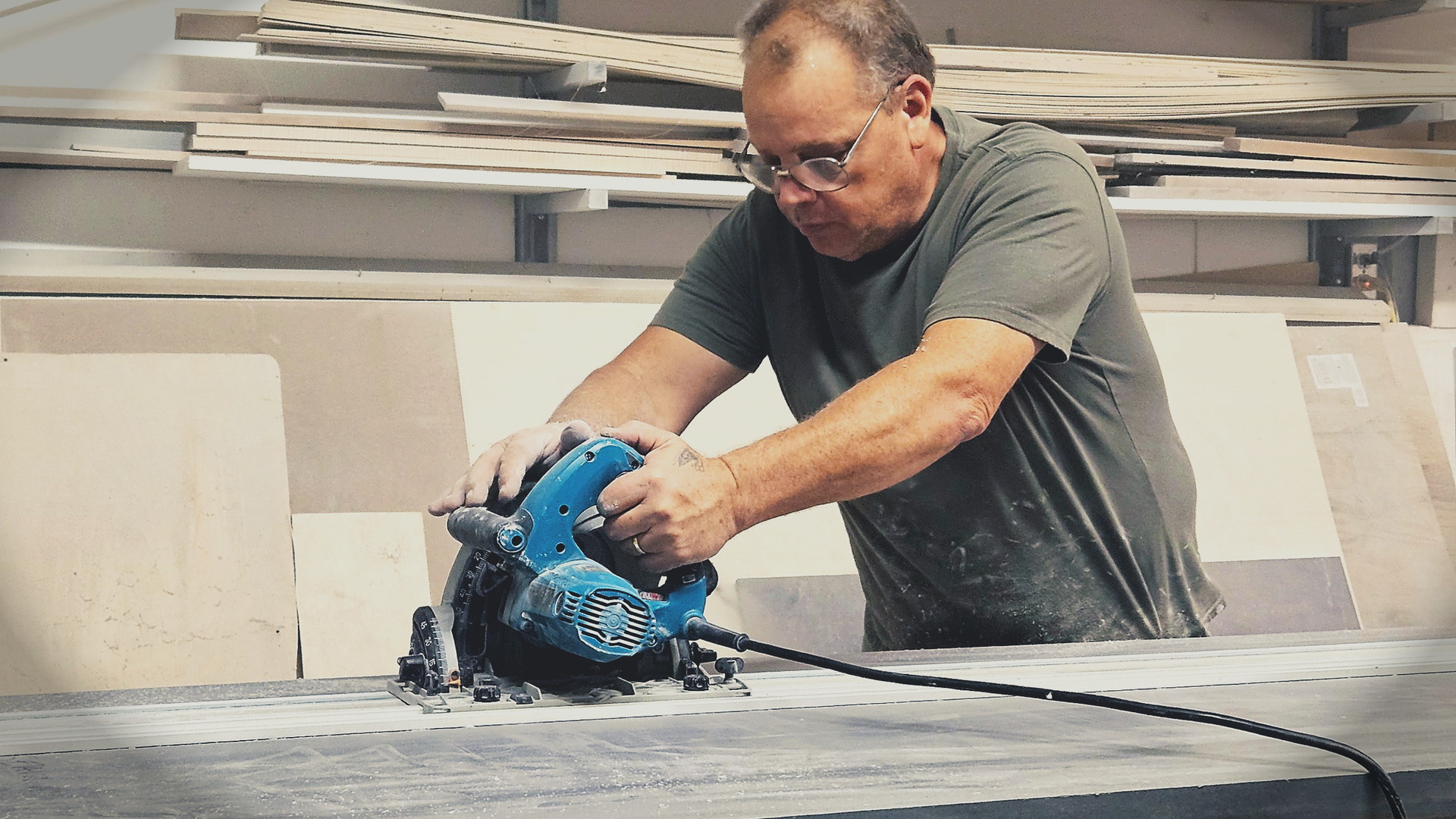
Experienced fabricators work with solid surface using many of the same tools and techniques found in a high-end joinery workshop. The material can be cut, routed, and sanded like a dense hardwood, allowing for a high degree of precision. However, it also has unique properties that require specialized knowledge. Understanding how different brands and formulations react to heat, which router bits to use for specific edge profiles, and the precise chemistry of the two-part adhesives are all critical elements of the craft. This is why many of the most skilled solid surface fabricators come from a background in carpentry or cabinet making.
It is a discipline that demands specialized tools, a deep understanding of material science, and an artist’s eye for detail. This technical complexity is what separates a master craftsman from a general installer, as the quality of the final product is a direct reflection of the fabricator’s expertise.
Steve’s career arc is a testament to the professionalization of the solid surface fabricator.
Mr. Cloutier’s 35 years of experience represent a continuous process of adaptation and learning, evolving alongside the industry itself. It is a fitting turn of history that Mr. Cloutier has spent the majority of his 35-year career in the greater Houston area. This geographical fact connects his personal story directly to the material’s commercial origins. This deep Houston rooting places Mr. Cloutier not just as an expert in his field, but as a craftsman whose professional life has unfolded at the historical epicenter of the industry he helped to build.
The Founding of Onmark LLC: A Commitment to Craftsmanship
After decades of honing his skills and deepening his expertise, Steve Cloutier founded Onmark LLC, a company built on the core principles of integrity, quality, and service. Onmark represents the culmination of this journey, a family-operated firm dedicated to the highest standards of solid surface fabrication. The company’s focus on providing tailored solutions for demanding environments such as modern residential kitchens, high-traffic medical facilities, and polished corporate offices, is a direct application of solid surface’s key benefits: seamless aesthetics, unparalleled hygiene, and long-term durability. Onmark is more than a fabrication shop; it is the embodiment of a master craftsman’s 35-year commitment to raising the standard in the solid surface industry.
The Future of Solid Surface and the Onmark Standard
As material science continues to advance, solid surface formulations will evolve, offering new colors, more complex patterns, and enhanced performance characteristics. In this ever-expanding landscape, the role of the master craftsman becomes more critical than ever. A company like Onmark LLC, founded on the 35 years of hands-on, in-the-trenches experience of a founder like Steve Cloutier, is positioned not merely as a fabricator of countertops, but as an essential consultant and partner in any solid surface project. By guiding clients through the complexities of material selection and delivering flawless execution, Onmark upholds the highest standard of craftsmanship; a standard whose commercial history began in Houston over 50 years ago and continues to be defined by a relentless commitment to precision, quality, and innovation. From modern kitchens to hygienic medical centers, the proof is in the finished product. Explore our project gallery to see how Onmark LLC applies a 35-year legacy of craftsmanship to every surface we create.